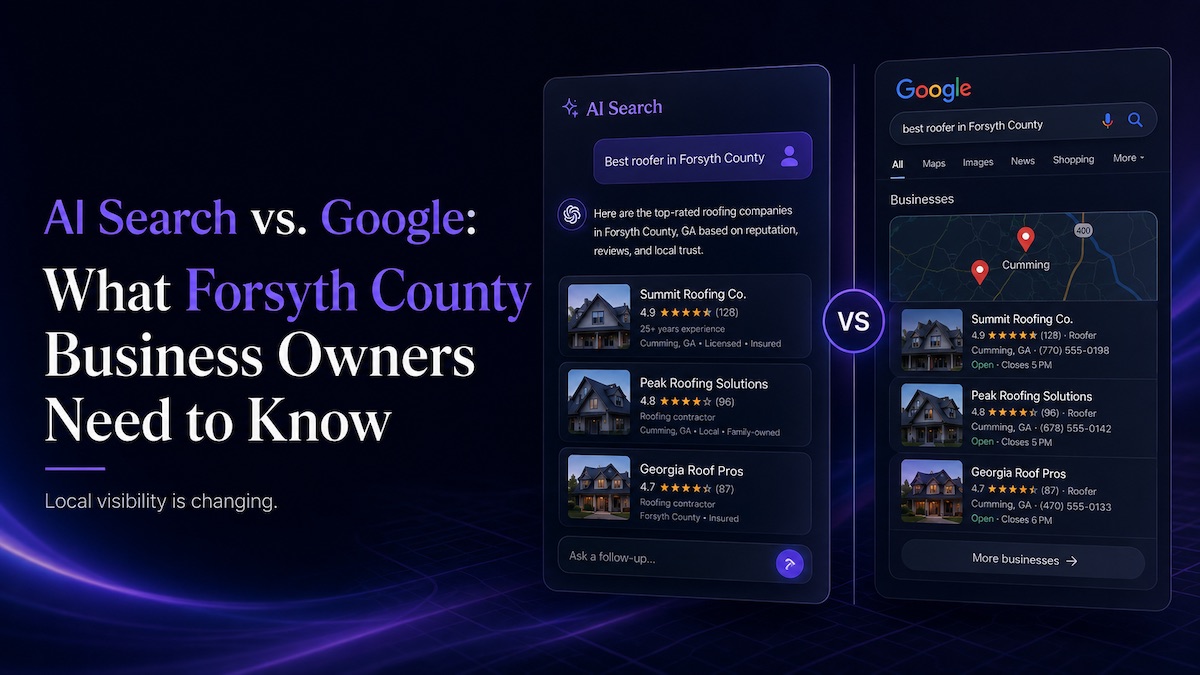
For twenty years, local marketing had one center of gravity: rank on Google, win the map pack, capture the click. That game still matters. But a second game has started alongside it, and it has different rules.
A growing share of your customers, especially younger homeowners and busy professionals, now skip the search results page entirely. They ask ChatGPT, Gemini, Claude, or Perplexity a question and act on the answer. "Who should I call about a broken AC in Cumming?" returns two or three names, not ten blue links. There's no page two. There's barely a page one.
The structural difference: a list you sort vs. an answer you trust
Google's classic model hands you options and lets you do the work: scan the results, compare reviews, open three tabs, form a judgment. The friction is yours.
AI search inverts that. The model does the comparing and judging, then hands you a conclusion. That's precisely why people like it, and precisely why the stakes are higher for businesses. In a Google result, position four still gets clicks. In an AI answer, there is no position four. You're recommended or you're absent.
Why your Google rankings don't automatically transfer
Some overlap exists: a business with great reviews and a strong web presence has a head start in both arenas. But the weighting is different in ways that catch businesses off guard.
Traditional Google rankings lean heavily on factors like backlink authority, keyword targeting, page experience, and proximity. AI recommendations lean harder on verifiability: review text and sentiment across platforms, consistency of your business data everywhere it appears, independent mentions in local news and community sources, and whether your website states plainly what you do and where. For a deeper breakdown of GEO, AEO, and how they differ from traditional SEO, see our complete guide to GEO, AEO, and local AI visibility.
We see the result of this constantly in our Forsyth County audits: businesses ranking on Google's first page that AI platforms never mention, because their presence is wide but shallow. And occasionally the reverse: a smaller operator with impeccable reviews and clean data getting recommended over a bigger competitor with a larger ad budget.
Why this matters more in high-trust industries
If you sell a $15 product, a missed recommendation is a rounding error. If you're a roofer, HVAC company, dentist, med spa, attorney, or chiropractor, a single customer is worth hundreds to thousands of dollars, and your customers are exactly the people most likely to ask an AI "who can I trust?" These are high-stakes, low-frequency decisions, which is when people most want a trusted referral rather than a list to research.
That's also why AI's behavior here is conservative. The platforms know recommendations carry weight, so they favor businesses they can verify from multiple angles. Trust signals aren't one ranking factor among many; they're the whole ballgame.
The practical takeaway
Don't abandon Google. The map pack and organic results still drive real volume, and the work overlaps: reviews, citations, and clear content help you in both games.
But stop assuming Google performance equals AI visibility. Test it. Ask the major AI platforms the questions your customers ask, in your service area, and see whose names come back. Our county-level research documents how often the AI answer diverges from the Google ranking, and it's more often than most owners expect.
The businesses that treat AI search as its own channel, with its own audit and its own plan, are building an advantage while their competitors are still optimizing for a results page fewer customers are reading. If you want to know where you stand, a free AI Visibility Audit is the fastest way to find out.